Home
›
Terra Kai organics garden berry
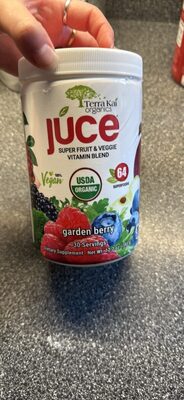
Limited data.
Nutrition facts panel is not on file for this product. The verdict reflects ingredient signals (NOVA, additive severity) only — not the full nutritional profile.
How it scored 43 / 100
Nutrition
—
No nutrition facts on file
Additives
0 / 30
Severity-weighted
Processing
0 / 10
NOVA group 4
Nutrition snapshot
Nutri-Score
ABCDE
EU 5-tier scale (worst)
NOVA group
4
Ultra-processed
Saturated fat
0 g
per 100 g
Serving
12 g
1 scoop (11.5 g)
Ingredients 72 listed
- 1 Prebiotic Fiber Blend —
- 2 Guar Gum Polysaccharide (galactomannan) extracted from the seeds of the guar plant (Cyamopsis tetragonoloba). E-number E412.Low
- 3 Inulin Naturally occurring fructan polysaccharide extracted primarily from chicory root; a soluble dietary fiber and prebiotic.Low
- 4 Flax Seed Seed of the flax plant (Linum usitatissimum), also known as linseed.Safe
- 5 Garden Vegetable —
- 6 Fruit Antioxidant Blend —
- 7 Apple Fruit of Malus domestica, eaten fresh or used in cooking and processing.Safe
- 8 Aloe Vera Aloe vera plant (Aloe barbadensis) — used as inner-leaf gel/juice in foods and beverages, and as whole-leaf extract in supplements.Moderate
- 9 Indian Gooseberry Fruit of Phyllanthus emblica (amla), a sour fruit native to South Asia, used fresh, dried, and as an extract.Low
- 10 Hordeum Vulgare Leaf Powder Powdered young leaves of the barley plant (Hordeum vulgare), commonly called barley grass powder.Safe
- 11 Cauliflower The white edible flower head of Brassica oleracea var. botrytis, a cruciferous vegetable.Safe
- 12 Celery Celery (Apium graveolens) is a marshland plant used as a vegetable.Low
- 13 Moringa Leaf —
- 14 Alfalfa Seeds Seeds of Medicago sativa (alfalfa) — used for sprouting (raw alfalfa sprouts).Moderate
- 15 Chlorella A genus of single-celled green freshwater algae (Chlorella vulgaris, C. pyrenoidosa) used as a nutritional supplement.Low
- 16 Spirulina Dried biomass of cyanobacteria (Arthrospira platensis or A. maxima); used as food, supplement, and natural blue color (phycocyanin extract).Low
- 17 Raspberry Raspberry (Rubus idaeus and related), a small red/black berry fruit.Safe
- 18 Blueberry Fruit of Vaccinium species (highbush, lowbush, rabbiteye blueberries).Safe
- 19 Strawberry Fruit of Fragaria × ananassa, eaten fresh, frozen, or processed.Safe
- 20 Carrot Edible taproot of the Daucus carota plant.Safe
- 21 Cranberry Tart red berry of Vaccinium macrocarpon, eaten fresh, dried, or as juice.Safe
- 22 Cherry Fruit of Prunus avium (sweet) or Prunus cerasus (sour) trees, eaten fresh, dried, or canned.Safe
- 23 Pomegranate Fruit of Punica granatum, containing juicy seed sacs (arils) inside a tough rind.Safe
- 24 Acai Berry Fruit of Euterpe oleracea palm, native to the Amazon; whole food rich in anthocyanins.Safe
- 25 Blackcurrant Berry of Ribes nigrum.Safe
- 26 Bilberry Small dark blue berries from Vaccinium myrtillus, related to blueberries, native to northern Europe.Safe
- 27 Banana Whole fruit of Musa species; sweet, soft, energy-dense, and rich in potassium.Safe
- 28 Pineapple Tropical fruit of Ananas comosus, eaten fresh, canned, or juiced.Safe
- 29 Papaya Fruit of Carica papaya L., a tropical tree in the Caricaceae family.Safe
- 30 Tomato Fruit of the Solanum lycopersicum plant.Safe
- 31 Acerola Fruit of Malpighia emarginata, exceptionally high in vitamin C.Safe
- 32 Blackberry The aggregate fruit of various Rubus species in the rose family.Safe
- 33 Mango Mango (Mangifera indica), a tropical stone fruit.Safe
- 34 Peach Whole fruit of Prunus persica.Safe
- 35 Pear Fruit of trees in the genus Pyrus; whole fruit eaten fresh or processed.Safe
- 36 Broccoli Edible green flowering head and stalk of Brassica oleracea var. italica.Safe
- 37 Savoy Cabbage A variety of cabbage (Brassica oleracea var. sabauda) with crinkled leaves, eaten as a vegetable.Safe
- 38 Kale A leafy green cruciferous vegetable (Brassica oleracea, Acephala group).Safe
- 39 Parsley Parsley is a culinary herb (Petroselinum crispum).Safe
- 40 Spinach Leafy green vegetable (Spinacia oleracea).Safe
- 41 Goji Goji berry, the fruit of Lycium barbarum, a Chinese boxthorn shrub; eaten dried, fresh, or as juice.Low
- 42 Elderberry Berry of Sambucus nigra and related species.Low
- 43 Grape Berry fruit of Vitis vinifera L. and related species in the Vitaceae family.Safe
- 44 Maqui Berry Dark purple berry from the Chilean tree Aristotelia chilensis, very high in anthocyanins.Safe
- 45 Citrus Immune Blend —
- 46 Orange Zest The colored outer peel of an orange, grated or peeled away from the bitter white pith.Safe
- 47 Lemon Peel Outer peel of the lemon fruit, often grated as zest or candied/dried.Safe
- 48 Probiotic Cultures Live microorganisms (typically Lactobacillus and Bifidobacterium species) added to or naturally present in fermented foods.Low
- 49 Lactobacillus Rhamnosus Probiotic lactic acid bacterium used in fermented foods and supplements.Safe
- 50 Bifidobacterium Bifidum A species of beneficial gut bacteria commonly used as a probiotic, particularly common in the infant gut.Safe
- 51 Long Pepper Spice from the dried fruit of Piper longum or Piper retrofractum, related to black pepper.Safe
- 52 Lactobacillus Acidophilus Probiotic lactic-acid bacterium used as a starter culture and live probiotic.Safe
- 53 Lactobacillus Casei A species of lactic acid bacteria used as a probiotic and starter culture.Safe
- 54 streptococcus thermophilus Proprietary Focus Blend —
- 55 American Ginseng Root Extract —
- 56 Coffee Beans Roasted seeds of Coffea arabica or Coffea canephora used to brew coffee.Low
- 57 Enzyme Industrial food enzyme — protein catalysts derived from plants, animals, or microorganisms (often via fermentation), added to food to perfor…Low
- 58 Acid Generic umbrella label for unspecified food acidulants (e.g., citric, malic, lactic, phosphoric, tartaric).Low
- 59 Protease Proteases are enzymes that hydrolyze peptide bonds in proteins; E1101 covers various microbial and animal-derived protease preparations.Low
- 60 Alkaline Protease —
- 61 Bromelain Mixture of proteolytic (protein-digesting) enzymes extracted from pineapple stem and fruit.Low
- 62 Papain Cysteine proteolytic enzyme isolated from papaya (Carica papaya) latex/fruit.Low
- 63 Cane Sugar Sucrose (a disaccharide of glucose and fructose) crystallized from sugar cane juice; chemically identical to beet sugar.Moderate
- 64 Natural Fruits Flavouring Natural fruits flavouring is a generic ingredient label referring to flavor preparations derived from real fruits via physical, microbiologi…Safe
- 65 Citric Acid Citric acid (E330), a weak organic acid naturally present in citrus fruit and produced commercially via Aspergillus niger fermentation.Low
- 66 Rebaudioside A A high-purity steviol glycoside extracted from Stevia rebaudiana leaves; one of several non-nutritive sweeteners derived from stevia.Low
- 67 Acacia Gum Dried sap of the Acacia tree (Acacia senegal/seyal); a complex polysaccharide also called gum arabic.Low
- 68 Beetroot The taproot of Beta vulgaris, a deep-red root vegetable. Also a source of natural color (beetroot red, E162).Safe
- 69 Euterpe oleracea —
- 70 Apple Fiber Dietary fiber isolated from apple pomace (cell wall residue after juicing).Safe
- 71 Green Tea Leaf Dried leaves of Camellia sinensis used for tea.Low
- 72 Cellulase Enzyme that hydrolyzes cellulose, used as a processing aid.Low
Scan it before you buy it
Get Ube for iOS and Android — point at any barcode, see what's actually in there.
Get the app