Home
›
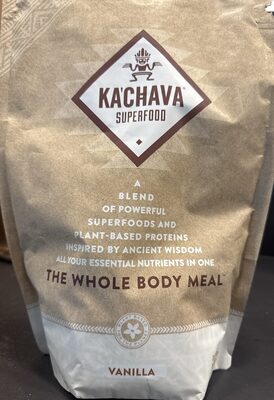
Ka’chava Superfood
Limited data.
Nutrition facts panel is not on file for this product. The verdict reflects ingredient signals (NOVA, additive severity) only — not the full nutritional profile.
How it scored 50 / 100
Nutrition
—
No nutrition facts on file
Additives
0 / 30
Severity-weighted
Processing
0 / 10
NOVA group 4
Nutrition snapshot
Nutri-Score
—
Not on file
NOVA group
4
Ultra-processed
Saturated fat
0 g
per 100 g
Serving
60 g
2 scoops (60 g)
Ingredients 80 listed
- 1 Thiamin Thiamin (vitamin B1) is an essential water-soluble B vitamin.Low
- 2 Riboflavin Riboflavin (vitamin B2), a water-soluble B vitamin. Used as a yellow-orange food color (E101) and as a vitamin fortificant.Low
- 3 Nicotinic Acid Nicotinic acid (niacin or vitamin B3, pyridine-3-carboxylic acid). E375 is the EU additive code for its use as a vitamin/nutrient added to f…Low
- 4 Vitamin B6 Pyridoxine (and related forms pyridoxal, pyridoxamine), a water-soluble B-vitamin essential for protein metabolism.Low
- 5 Folate A B-vitamin (vitamin B9) occurring naturally in foods (folate) and added as folic acid in fortification.Low
- 6 Vitamin B12 Vitamin B12 (cobalamin) is an essential water-soluble vitamin.Low
- 7 D-Biotin D-biotin (vitamin B7/H), a water-soluble vitamin essential for fatty acid and amino acid metabolism.Low
- 8 Pantothenic Acid Vitamin B5 - water-soluble vitamin essential for synthesis of coenzyme A and acyl carrier protein. Pale-yellow viscous liquid; commonly supp…Low
- 9 Iron Mineral element; essential micronutrient. In food, typically appears as ferrous sulfate, ferric orthophosphate, or reduced iron.Low
- 10 Phosphorus Essential mineral nutrient typically present in foods as phosphate; listed as a nutrient on labels.Low
- 11 Iodine An essential trace mineral required for thyroid hormone synthesis; commonly added to salt as potassium iodide or potassium iodate.Low
- 12 Magnesium Essential dietary mineral; in foods often added as fortificant (e.g., magnesium oxide, citrate, sulfate).Low
- 13 Zinc An essential mineral added to foods (often as zinc oxide, zinc sulfate, or zinc gluconate) for fortification.Low
- 14 Selenium Essential trace mineral used as a nutritional fortificant, typically as sodium selenite or selenomethionine.Low
- 15 Copper Copper as an essential trace mineral, used as nutrient (e.g., copper sulfate, gluconate).Low
- 16 Manganese Essential trace mineral (Mn), required for several enzyme systems including superoxide dismutase.Low
- 17 Chromium Trace mineral; nutritionally relevant form is trivalent chromium (Cr III), often as chromium picolinate or chromium chloride in supplements/…Low
- 18 Molybdenum Trace mineral essential for several enzymes (e.g., sulfite oxidase, xanthine oxidase).Low
- 19 Salt Sodium chloride (NaCl), a crystalline mineral compound composed of roughly 40% sodium and 60% chloride by mass.Low
- 20 Potassium Essential dietary mineral; the most abundant intracellular cation.Low
- 21 Coconut Flower Nectar —
- 22 Acai Berry Fruit of Euterpe oleracea palm, native to the Amazon; whole food rich in anthocyanins.Safe
- 23 Maqui Berry Dark purple berry from the Chilean tree Aristotelia chilensis, very high in anthocyanins.Safe
- 24 Camu-Camu Berry —
- 25 Strawberry Fruit of Fragaria × ananassa, eaten fresh, frozen, or processed.Safe
- 26 Tangerine Citrus tangerina, a small citrus fruit related to mandarin oranges.Safe
- 27 Blackberry The aggregate fruit of various Rubus species in the rose family.Safe
- 28 Blueberry Fruit of Vaccinium species (highbush, lowbush, rabbiteye blueberries).Safe
- 29 Raspberry Raspberry (Rubus idaeus and related), a small red/black berry fruit.Safe
- 30 Maca Root of Lepidium meyenii, a Peruvian Andean plant in the cruciferous family; sold as flour or extract.Low
- 31 Shiitake Mushroom Mycelia —
- 32 Maitake Mushroom Mycelia —
- 33 Reishi Mushroom Mycelia —
- 34 Cordyceps Militaris Mycelium Extract Extract from the mycelium of Cordyceps militaris, a parasitic fungus traditionally used in East Asian medicine.Low
- 35 Ginger The rhizome of Zingiber officinale, used fresh, dried, or powdered as a spice and traditional medicine.Safe
- 36 Beetroot The taproot of Beta vulgaris, a deep-red root vegetable. Also a source of natural color (beetroot red, E162).Safe
- 37 Carrot Edible taproot of the Daucus carota plant.Safe
- 38 Spinach Leafy green vegetable (Spinacia oleracea).Safe
- 39 Broccoli Edible green flowering head and stalk of Brassica oleracea var. italica.Safe
- 40 Tomato Fruit of the Solanum lycopersicum plant.Safe
- 41 Kale A leafy green cruciferous vegetable (Brassica oleracea, Acephala group).Safe
- 42 Cabbage Whole leafy vegetable (Brassica oleracea var. capitata).Safe
- 43 Parsley Parsley is a culinary herb (Petroselinum crispum).Safe
- 44 Brussels Sprouts Edible buds of Brassica oleracea (Gemmifera Group); a cruciferous vegetable.Safe
- 45 Green Bell Pepper Whole vegetable; immature fruit of Capsicum annuum, low in calories and rich in vitamin C.Safe
- 46 Cucumber Fresh fruit of Cucumis sativus, a member of the gourd family, consumed raw or pickled.Safe
- 47 Celery Celery (Apium graveolens) is a marshland plant used as a vegetable.Low
- 48 Garlic Allium sativum, a bulbous plant whose cloves are rich in organosulfur compounds — most notably allicin (formed when garlic is crushed) — plu…Safe
- 49 Spring Onion Young Allium cepa harvested before the bulb fully matures; also called scallion or green onion.Safe
- 50 Cauliflower The white edible flower head of Brassica oleracea var. botrytis, a cruciferous vegetable.Safe
- 51 Asparagus Edible young shoots of Asparagus officinalis.Safe
- 52 Chlorella A genus of single-celled green freshwater algae (Chlorella vulgaris, C. pyrenoidosa) used as a nutritional supplement.Low
- 53 Inulin Naturally occurring fructan polysaccharide extracted primarily from chicory root; a soluble dietary fiber and prebiotic.Low
- 54 Lactobacillus Rhamnosus Probiotic lactic acid bacterium used in fermented foods and supplements.Safe
- 55 Lactobacillus Acidophilus Probiotic lactic-acid bacterium used as a starter culture and live probiotic.Safe
- 56 Alpha-Amylase Alpha-amylase, an enzyme that hydrolyzes starch into shorter saccharides.Low
- 57 Protease Proteases are enzymes that hydrolyze peptide bonds in proteins; E1101 covers various microbial and animal-derived protease preparations.Low
- 58 Cellulase Enzyme that hydrolyzes cellulose, used as a processing aid.Low
- 59 Lactase Beta-galactosidase enzyme that hydrolyzes lactose into glucose and galactose, produced from microbial sources (e.g., Aspergillus oryzae, Klu…Low
- 60 Lipase Lipase, an enzyme that hydrolyzes triglycerides; produced from animal pancreas or microbial fermentation.Low
- 61 Coconut Milk An emulsion produced by grating mature coconut meat and squeezing it with water; rich in saturated medium-chain fats.Low
- 62 Natural Vanilla Flavouring Flavoring derived from vanilla beans (Vanilla planifolia), as extract or natural flavor preparation in compliance with FDA standard of ident…Safe
- 63 Vegetable Fiber A generic umbrella term referring to non-specified dietary fiber sourced from vegetables.Safe
- 64 Xanthan Gum Xanthan gum is a high-molecular-weight polysaccharide produced by aerobic fermentation of glucose or sucrose by the bacterium Xanthomonas ca…Low
- 65 Fruit Extract A non-specific umbrella term for liquid or powdered concentrates derived from fruits, often used for color, flavor, or as a natural sweetene…Low
- 66 Thiamin Hydrochloride The hydrochloride salt of thiamin (vitamin B1), an essential water-soluble vitamin.Low
- 67 Pyridoxine Hydrochloride Pyridoxine hydrochloride is a synthetic form of vitamin B6 used for nutrient fortification.Low
- 68 Cyanocobalamin Synthetic form of vitamin B12 (cobalamin); essential micronutrient containing cobalt.Low
- 69 Calcium D-Pantothenate Safe
- 70 Tricalcium Phosphate Calcium phosphate compound (Ca3(PO4)2) used as anticaking agent, calcium fortificant, and pH regulator.Low
- 71 Potassium Iodide Inorganic salt (KI) used to iodize salt and fortify foods; provides bioavailable iodine.Low
- 72 Magnesium Oxide Magnesium oxide (E530), a white powder produced from magnesium ores.Low
- 73 Zinc Oxide Inorganic zinc compound (ZnO) used as a source of zinc nutrient in foods and supplements.Low
- 74 as copper amino acid chelate —
- 75 Sodium Chloride Moderate
- 76 Cocos nucifera flower bud —
- 77 Euterpe oleracea —
- 78 Aristotelia chilensis —
- 79 Myrciaria dubia —
- 80 Lepidium meyenii root —
Scan it before you buy it
Get Ube for iOS and Android — point at any barcode, see what's actually in there.
Get the app