Home
›
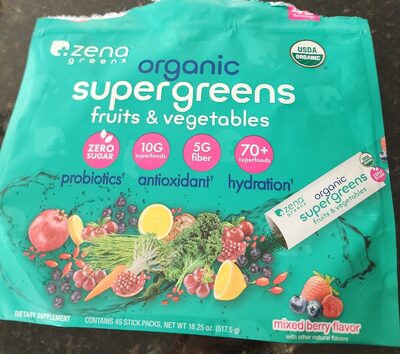
zena greens organic supergreens fruits & vegetables
Limited data.
Nutrition facts panel is not on file for this product. The verdict reflects ingredient signals (NOVA, additive severity) only — not the full nutritional profile.
How it scored 50 / 100
Nutrition
—
No nutrition facts on file
Additives
0 / 30
Severity-weighted
Processing
0 / 10
NOVA group 4
Nutrition snapshot
Nutri-Score
—
Not on file
NOVA group
4
Ultra-processed
Saturated fat
—
No nutriment data
Serving
12 g
1 stick (11.5 g)
Ingredients 101 listed
- 1 Acacia Gum Dried sap of the Acacia tree (Acacia senegal/seyal); a complex polysaccharide also called gum arabic.Low
- 2 Oryza Sativa Hull Powder Powdered rice hulls, the outer protective layer of rice grain (Oryza sativa).Low
- 3 Inulin Naturally occurring fructan polysaccharide extracted primarily from chicory root; a soluble dietary fiber and prebiotic.Low
- 4 Prebiotics Generic umbrella term for non-digestible food components (mainly fibers) that selectively stimulate beneficial gut bacteria — e.g., inulin, …Low
- 5 Probiotic Cultures Live microorganisms (typically Lactobacillus and Bifidobacterium species) added to or naturally present in fermented foods.Low
- 6 Spirulina Dried biomass of cyanobacteria (Arthrospira platensis or A. maxima); used as food, supplement, and natural blue color (phycocyanin extract).Low
- 7 Spinach Leafy green vegetable (Spinacia oleracea).Safe
- 8 Wheat Grass Young grass shoots of the common wheat plant (Triticum aestivum), harvested before jointing.Low
- 9 Hordeum Vulgare Leaf Powder Powdered young leaves of the barley plant (Hordeum vulgare), commonly called barley grass powder.Safe
- 10 Oat Grass Young green leaves of the oat plant (Avena sativa) harvested before grain formsSafe
- 11 Alfalfa Forage legume (Medicago sativa); leaves, sprouts, and seeds are consumed as food/herb.Low
- 12 Kale A leafy green cruciferous vegetable (Brassica oleracea, Acephala group).Safe
- 13 Antioxidant Blend Umbrella term for a mixture of antioxidant ingredients (commonly tocopherols, ascorbic acid, rosemary extract, citric acid, BHT/BHA in some …Moderate
- 14 Carrot Edible taproot of the Daucus carota plant.Safe
- 15 Cauliflower The white edible flower head of Brassica oleracea var. botrytis, a cruciferous vegetable.Safe
- 16 Chlorella A genus of single-celled green freshwater algae (Chlorella vulgaris, C. pyrenoidosa) used as a nutritional supplement.Low
- 17 Garlic Allium sativum, a bulbous plant whose cloves are rich in organosulfur compounds — most notably allicin (formed when garlic is crushed) — plu…Safe
- 18 Moringa Leaves and powder from Moringa oleifera, a tree native to South Asia, used as a nutrient-dense food and supplement.Safe
- 19 Onion The edible bulb of Allium cepa L., a widely cultivated vegetable in the Allium family that also includes garlic, shallots, and leeks.Safe
- 20 Parsley Parsley is a culinary herb (Petroselinum crispum).Safe
- 21 Quinoa The seed of Chenopodium quinoa, a pseudocereal native to the Andes; complete plant protein.Safe
- 22 Hebridean Seaweed —
- 23 Ashwagandha Adaptogenic root extract from Withania somnifera (Indian ginseng), used in Ayurvedic medicine and dietary supplements.Moderate
- 24 Ginger The rhizome of Zingiber officinale, used fresh, dried, or powdered as a spice and traditional medicine.Safe
- 25 Cinnamon Ground bark of trees in the Cinnamomum genus (typically C. verum or C. cassia).Safe
- 26 Cocoa Powder Processed With Alkali Cocoa powder (a.k.a. 'Dutch-processed' or 'Dutched' cocoa) treated with food-grade alkali (e.g., potassium carbonate) to neutralize acidity …Low
- 27 Flax Seed Seed of the flax plant (Linum usitatissimum), also known as linseed.Safe
- 28 Maca Root of Lepidium meyenii, a Peruvian Andean plant in the cruciferous family; sold as flour or extract.Low
- 29 Asparagus Racemosus Root Powder Powdered root of Asparagus racemosus, known as shatavari — a traditional Ayurvedic herb.Low
- 30 Green Tea Beverage or extract from steamed/dried unoxidized leaves of Camellia sinensis.Safe
- 31 Extract Generic umbrella term for a concentrated solvent-based preparation of a food, herb, or spice.Safe
- 32 Sea Veggie Blend —
- 33 Broccoli Edible green flowering head and stalk of Brassica oleracea var. italica.Safe
- 34 Cabbage Whole leafy vegetable (Brassica oleracea var. capitata).Safe
- 35 Celery Celery (Apium graveolens) is a marshland plant used as a vegetable.Low
- 36 Green Bell Pepper Whole vegetable; immature fruit of Capsicum annuum, low in calories and rich in vitamin C.Safe
- 37 Coconut Water Clear liquid found inside young green coconuts.Safe
- 38 Lemon Juice Liquid pressed from the fruit Citrus limon.Safe
- 39 Mixed Mushrooms Generic blend of edible mushroom species (e.g., Agaricus bisporus, shiitake, oyster, portobello).Safe
- 40 Enzyme Industrial food enzyme — protein catalysts derived from plants, animals, or microorganisms (often via fermentation), added to food to perfor…Low
- 41 Natural Flavouring A regulatory umbrella term (21 CFR 101.22) for flavor extracts derived from spices, fruit, vegetable, herb, bark, root, leaf, meat, seafood,…Low
- 42 Citric Acid Citric acid (E330), a weak organic acid naturally present in citrus fruit and produced commercially via Aspergillus niger fermentation.Low
- 43 Steviol Glycosides Sweet glycoside compounds (rebaudioside A, stevioside, etc.) extracted from leaves of Stevia rebaudiana, 200-300x sweeter than sucrose.Low
- 44 Lactobacillus Rhamnosus Probiotic lactic acid bacterium used in fermented foods and supplements.Safe
- 45 Lactiplantibacillus Plantarum A lactic acid bacterium (formerly Lactobacillus plantarum) used as a probiotic and starter culture.Low
- 46 P Insufficient information; the entry 'P' is ambiguous and does not correspond to a clearly identifiable ingredient.Low
- 47 Lactobacillus Acidophilus Probiotic lactic-acid bacterium used as a starter culture and live probiotic.Safe
- 48 Lactobacillus Genus of lactic-acid bacteria used as starter cultures and probiotics in fermented foods.Safe
- 49 Long Pepper Spice from the dried fruit of Piper longum or Piper retrofractum, related to black pepper.Safe
- 50 Bifidobacterium Lactis Probiotic species Bifidobacterium animalis subsp. lactis; gut-resident bacterium used in supplements and fermented foods.Low
- 51 Plant Generic umbrella term referring to plant-derived ingredients of unspecified species or part.Safe
- 52 Leaf and Stalk —
- 53 Pomegranate Juice Juice extracted from pomegranate fruit (Punica granatum).Low
- 54 Acai Juice Juice from the açaí palm fruit (Euterpe oleracea), a Brazilian berry rich in anthocyanins and fats.Safe
- 55 Goji Goji berry, the fruit of Lycium barbarum, a Chinese boxthorn shrub; eaten dried, fresh, or as juice.Low
- 56 Grape Juice Juice obtained from pressing grapes (Vitis species). Sold as 100% juice or as a sweetener concentrate.Low
- 57 Amla Fruit Powder —
- 58 Cranberry Tart red berry of Vaccinium macrocarpon, eaten fresh, dried, or as juice.Safe
- 59 Chokeberry The fruit of Aronia melanocarpa (black chokeberry) or related species, rich in anthocyanins and polyphenols.Safe
- 60 Sea-Buckthorn Juice Juice extracted from the orange berries of the sea buckthorn shrub (Hippophae rhamnoides).Safe
- 61 Camu Camu Powder —
- 62 Acerola Juice Juice from the acerola cherry (Malpighia emarginata), notably high in vitamin C.Safe
- 63 Maqui Berry Dark purple berry from the Chilean tree Aristotelia chilensis, very high in anthocyanins.Safe
- 64 Whole Taproot —
- 65 Flower and Stem —
- 66 Root Bulb —
- 67 Brown Rice Whole grain rice with the bran and germ intact (only the inedible hull removed).Low
- 68 Pea Protein Plant protein isolated from yellow split peas (Pisum sativum) by wet or dry processing.Low
- 69 Sacha Inchi Powder —
- 70 Pumpkin Seed Protein Powder —
- 71 Root —
- 72 Bark —
- 73 Laminaria hyperborea —
- 74 Ascophyllum Nodosum Knotted wrack — a brown seaweed (Ascophyllum nodosum) eaten as food/supplement and used as fertilizer/feed.Low
- 75 Laminaria digitata —
- 76 Whole Thallus —
- 77 Floret and Stalk —
- 78 Fruit Generic umbrella term for fruit ingredients; not a specific fruit identification.Safe
- 79 Cordyceps Fungi of the genus Cordyceps (most commonly Cordyceps militaris and Cordyceps sinensis / Ophiocordyceps sinensis), used in traditional East …Low
- 80 Reshi —
- 81 Maitake —
- 82 Lion's Mane —
- 83 Chaga Inonotus obliquus, a medicinal mushroom that grows on birch treesModerate
- 84 Shiitake Edible mushroom (Lentinula edodes) used fresh or dried.Safe
- 85 Oyster Edible bivalve mollusks (genus Crassostrea/Ostrea); consumed raw or cooked.Low
- 86 Oxtail The tail of cattle (beef oxtail) — a bone-in cut rich in connective tissue and gelatin.Low
- 87 Tremella Fuciformis Snow fungus / silver ear mushroom, an edible jelly fungus used in East Asian cuisine and traditional medicine.Safe
- 88 White Button —
- 89 Oyster Mushroom Edible fungus (Pleurotus ostreatus) cultivated worldwide; characterized by oyster-shaped fan caps and mild flavor.Safe
- 90 Cellulase Enzyme that hydrolyzes cellulose, used as a processing aid.Low
- 91 Alpha-Amylase Alpha-amylase, an enzyme that hydrolyzes starch into shorter saccharides.Low
- 92 Protease Proteases are enzymes that hydrolyze peptide bonds in proteins; E1101 covers various microbial and animal-derived protease preparations.Low
- 93 Cordyceps militaris —
- 94 Cordyceps sinensis —
- 95 Ganoderma lucidum —
- 96 Grifola frondosa —
- 97 Hericium erinaceus —
- 98 Inonotus obliquus —
- 99 Trametes versicolor —
- 100 Cultivated Mushroom Commercially grown edible fungi, typically Agaricus bisporus (white button, cremini, portobello).Safe
- 101 Pleurotus eryngii —
Scan it before you buy it
Get Ube for iOS and Android — point at any barcode, see what's actually in there.
Get the app