Home
›
Abbott Similac Advance
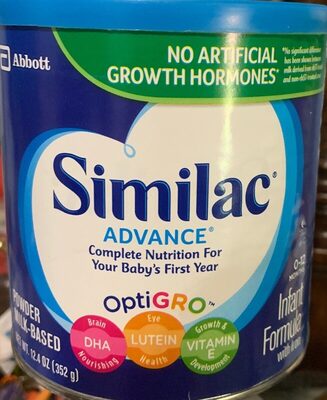
Limited data.
Nutrition facts panel is not on file for this product. The verdict reflects ingredient signals (NOVA, additive severity) only — not the full nutritional profile.
How it scored 90 / 100
Nutrition
—
No nutrition facts on file
Additives
0 / 30
Severity-weighted
Processing
0 / 10
NOVA group 4
Nutrition snapshot
Nutri-Score
—
Not on file
NOVA group
4
Ultra-processed
Saturated fat
—
No nutriment data
Serving
148 g
148ml
Ingredients 42 listed
- 1 Skimmed Milk Cow's milk from which most milkfat has been removed. FDA standard of identity for nonfat milk requires <0.5% milkfat; for nonfat dry milk, <…Safe
- 2 Lactose Disaccharide sugar (glucose + galactose) naturally present in milk; commercially produced from wheyLow
- 3 Safflower Oil Edible oil pressed from safflower seeds (Carthamus tinctorius); high-linoleic or high-oleic variants.Safe
- 4 Whey Protein Protein fraction isolated from milk whey, the liquid by-product of cheese making, typically as concentrate or isolate powder.Low
- 5 Galacto-Oligosaccharides Short-chain carbohydrates (GOS) produced enzymatically from lactose, used as prebiotic fibers.Low
- 6 Alchemilla Alpina Extract Extract from Alchemilla alpina (alpine lady's mantle), a herbal botanical.Low
- 7 Beta 'Beta' alone is not a defined food ingredient; it is a fragmentary or truncated label entry that lacks specificity.Low
- 8 Beta-Carotene Beta-carotene, an orange-yellow carotenoid pigment that is a vitamin A precursor, sourced from plants (carrots, palm fruit, algae) or made s…Low
- 9 Lutein Lutein (E161b), a yellow-orange xanthophyll carotenoid extracted primarily from marigold flowers (Tagetes erecta) or alfalfa.Low
- 10 Lycopene Lycopene, a red carotenoid pigment found naturally in tomatoes; used as a food color.Low
- 11 Tripotassium Citrate Tripotassium citrate — potassium salt of citric acid.Low
- 12 Calcium Carbonate Calcium carbonate (CaCO3), a naturally occurring mineral (limestone, chalk) used as a calcium source, anticaking agent, and pH regulator in …Low
- 13 Ascorbic Acid L-Ascorbic acid (vitamin C), a water-soluble vitamin and reducing agent.Low
- 14 Soya Lecithin A naturally occurring mixture of phospholipids (phosphatidylcholine, phosphatidylethanolamine, phosphatidylinositol) extracted from soybean …Low
- 15 Magnesium Chloride Magnesium chloride (MgCl2); mineral salt.Low
- 16 Ferrous Sulfate An iron(II) sulfate salt (FeSO4) used as an iron source for food fortification and dietary supplements.Low
- 17 Choline Bitartrate Choline bitartrate is the bitartrate salt of choline, used as a dietary source of choline.Low
- 18 Choline Chloride Quaternary ammonium salt providing the essential nutrient choline.Low
- 19 Ascorbyl Palmitate Ascorbyl palmitate, a fat-soluble ester of vitamin C and palmitic acid (E304(i)).Low
- 20 Salt Sodium chloride (NaCl), a crystalline mineral compound composed of roughly 40% sodium and 60% chloride by mass.Low
- 21 Taurine A sulfur-containing amino-sulfonic acid naturally found in animal tissues; commercially synthesized for use in supplements and energy drinks…Low
- 22 Inositol Carbohydrate alcohol (cyclohexane-1,2,3,4,5,6-hexol); myo-inositol is the dominant form. Naturally present in many foods (cantaloupe, citrus…Low
- 23 Zinc Sulfate Inorganic zinc salt (ZnSO4) used as a nutrient fortificant and dietary supplement.Low
- 24 Tocopherol-Rich Extract Tocopherol-rich extract — a natural extract of mixed tocopherols (vitamin E forms) from vegetable oils, used as a natural antioxidant.Low
- 25 Disodium Uridine-Monophosphate Disodium salt of uridine 5'-monophosphate, a ribonucleotide.Low
- 26 Cytidine Monophosphate Nucleotide composed of cytosine, ribose, and a phosphate group; added to infant formulas and supplements.Low
- 27 Manganese Sulfate An inorganic salt (MnSO4) used as a manganese source in food fortification and supplements.Low
- 28 Phylloquinone Vitamin K1, the natural plant form of vitamin K, used as a fortification ingredient.Low
- 29 D-Biotin D-biotin (vitamin B7/H), a water-soluble vitamin essential for fatty acid and amino acid metabolism.Low
- 30 Cholecalciferol Vitamin D3, the form of vitamin D synthesized in skin from UVB exposure or obtained from animal sources.Low
- 31 CALCUM COPPER SULFATE —
- 32 Thiamin Hydrochloride The hydrochloride salt of thiamin (vitamin B1), an essential water-soluble vitamin.Low
- 33 Riboflavin Riboflavin (vitamin B2), a water-soluble B vitamin. Used as a yellow-orange food color (E101) and as a vitamin fortificant.Low
- 34 Pyridoxine Hydrochloride Pyridoxine hydrochloride is a synthetic form of vitamin B6 used for nutrient fortification.Low
- 35 Folic Acid Synthetic form of folate (vitamin B9). Pteroylmonoglutamic acid, a water-soluble B vitamin essential for DNA synthesis and red blood cell fo…Low
- 36 Tocopheryl Acetate Acetate ester of alpha-tocopherol (vitamin E); more stable than free tocopherol.Low
- 37 Nicotinic Acid Nicotinic acid (niacin or vitamin B3, pyridine-3-carboxylic acid). E375 is the EU additive code for its use as a vitamin/nutrient added to f…Low
- 38 Calcium Pantothenate Calcium salt of pantothenic acid (vitamin B5); the most common supplemental form of B5.Low
- 39 L-Carnitine L-carnitine — quaternary ammonium compound naturally synthesized from lysine and methionine; transports fatty acids into mitochondria.Low
- 40 Retinyl Palmitate Ester of retinol (vitamin A) and palmitic acid; preformed vitamin A.Low
- 41 Magnesium Sulphate Magnesium sulfate (E518) is an inorganic salt used as a firming agent, magnesium fortificant, and processing aid.Low
- 42 THAMINE HYDROCHLORIDE —
Scan it before you buy it
Get Ube for iOS and Android — point at any barcode, see what's actually in there.
Get the app