Home
›
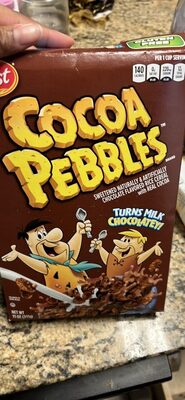
Cocoa Pebbles Sweetened Naturally & Artificially Flavored Rice Cereal with Real Cocoa
Why this verdict: 1 high-concern ingredient(s) present.
Limited data.
Nutrition facts panel is not on file for this product. The verdict reflects ingredient signals (NOVA, additive severity) only — not the full nutritional profile.
How it scored 25 / 100
Nutrition
—
No nutrition facts on file
Additives
0 / 30
Severity-weighted
Processing
0 / 10
NOVA group 4
Nutrition snapshot
Nutri-Score
ABCDE
EU 5-tier scale (best)
NOVA group
4
Ultra-processed
Saturated fat
—
No nutriment data
Serving
36 g
1 cup (36 g)
Ingredients 23 listed
- 1 Rice Edible cereal grain (Oryza sativa), the seed of the rice plant, consumed as a staple food.Safe
- 2 Sugar Sucrose, a disaccharide of glucose and fructose, refined from sugarcane or sugar beets.Moderate
- 3 Canola Canola (Brassica napus) — typically refers to canola oil, a low-erucic-acid rapeseed oil.Low
- 4 Soya Oil Vegetable oil extracted from soybeans (Glycine max), typically refined, bleached, and deodorized. High in polyunsaturated fats, particularly…Low
- 5 Cocoa Powder produced from roasted, ground cocoa beans (Theobroma cacao) with most of the cocoa butter removed.Safe
- 6 Salt Sodium chloride (NaCl), a crystalline mineral compound composed of roughly 40% sodium and 60% chloride by mass.Low
- 7 Natural And Artificial Flavouring A blanket label for proprietary flavor mixtures combining naturally derived flavor constituents (essential oils, extracts, distillates) with…Low
- 8 Butylated Hydroxytoluene Butylated hydroxytoluene (BHT), a synthetic phenolic antioxidant used to prevent fat oxidation.High
- 9 Vitamins Generic umbrella term for fortification with one or more essential vitamins (A, B-complex, C, D, E, K, etc.).Low
- 10 Minerals Generic umbrella term for inorganic nutrient additives (e.g., calcium carbonate, ferrous sulfate, zinc oxide, potassium iodide).Safe
- 11 Reduced Iron Elemental iron powder (Fe) produced by reducing iron oxide with hydrogen or carbon monoxide; used as a food fortificant.Low
- 12 Zinc Oxide Inorganic zinc compound (ZnO) used as a source of zinc nutrient in foods and supplements.Low
- 13 Retinyl Palmitate Ester of retinol (vitamin A) and palmitic acid; preformed vitamin A.Low
- 14 Pyridoxine Hydrochloride Pyridoxine hydrochloride is a synthetic form of vitamin B6 used for nutrient fortification.Low
- 15 Thiamin Mononitrate Synthetic, stable form of vitamin B1 (thiamine). The nitrate salt is preferred for fortification because it tolerates heat and humidity bett…Low
- 16 Riboflavin Riboflavin (vitamin B2), a water-soluble B vitamin. Used as a yellow-orange food color (E101) and as a vitamin fortificant.Low
- 17 Folic Acid Synthetic form of folate (vitamin B9). Pteroylmonoglutamic acid, a water-soluble B vitamin essential for DNA synthesis and red blood cell fo…Low
- 18 Cholecalciferol Vitamin D3, the form of vitamin D synthesized in skin from UVB exposure or obtained from animal sources.Low
- 19 Vitamin B12 Vitamin B12 (cobalamin) is an essential water-soluble vitamin.Low
- 20 Plain Caramel Plain (Class I) caramel colour, produced by controlled heat treatment of carbohydrates without ammonium or sulphite compounds. Of the four c…Low
- 21 Nicotinic Acid Nicotinic acid (niacin or vitamin B3, pyridine-3-carboxylic acid). E375 is the EU additive code for its use as a vitamin/nutrient added to f…Low
- 22 Vitamin B6 Pyridoxine (and related forms pyridoxal, pyridoxamine), a water-soluble B-vitamin essential for protein metabolism.Low
- 23 Thiamin Thiamin (vitamin B1) is an essential water-soluble B vitamin.Low
Scan it before you buy it
Get Ube for iOS and Android — point at any barcode, see what's actually in there.
Get the app