Home
›
Wheat Thins Vegetable Thins
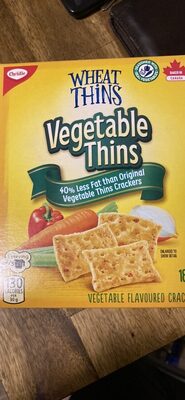
Limited data.
Nutrition facts panel is not on file for this product. The verdict reflects ingredient signals (NOVA, additive severity) only — not the full nutritional profile.
How it scored 38 / 100
Nutrition
—
No nutrition facts on file
Additives
0 / 30
Severity-weighted
Processing
0 / 10
NOVA group 4
Nutrition snapshot
Nutri-Score
ABCDE
EU 5-tier scale (worst)
NOVA group
4
Ultra-processed
Saturated fat
—
No nutriment data
Serving
30 g
1 serving (30 g)
Ingredients 26 listed
- 1 Wheat Flour Powder ground from wheat grain (Triticum aestivum). Contains starch, gluten-forming proteins (gliadin, glutenin), bran, and germ depending o…Low
- 2 Fat Generic umbrella term for solid lipids; may refer to many specific animal or vegetable fats.Low
- 3 Dried Vegetables Generic umbrella term for vegetables dehydrated by air, sun, freeze-drying, or drum drying. The specific vegetables are not disclosed.Moderate
- 4 Mixed Condiments Generic umbrella label for an unspecified blend of condiments (e.g., ketchup, mustard, mayonnaise, sauces).Low
- 5 Ammonium Hydrogen Carbonate Ammonium hydrogen carbonate / ammonium bicarbonate (E503ii), an inorganic salt that decomposes on heating into water, CO2, and ammonia.Low
- 6 Salt Sodium chloride (NaCl), a crystalline mineral compound composed of roughly 40% sodium and 60% chloride by mass.Low
- 7 Monocalcium Phosphate Monocalcium phosphate (Ca(H2PO4)2), an inorganic acid salt.Low
- 8 Sodium Hydrogen Carbonate Sodium hydrogen carbonate (sodium bicarbonate, NaHCO3), commonly known as baking soda.Low
- 9 Hydrolysed Soy Protein Soy protein broken down by acid or enzymatic hydrolysis into peptides and free amino acids; high in glutamic acid.Moderate
- 10 Alpha-Amylase Alpha-amylase, an enzyme that hydrolyzes starch into shorter saccharides.Low
- 11 Protease Proteases are enzymes that hydrolyze peptide bonds in proteins; E1101 covers various microbial and animal-derived protease preparations.Low
- 12 Vegetable Oil Generic term covering edible oils extracted from plant sources (soybean, canola, corn, sunflower, palm, etc.).Low
- 13 Modified Palm Oil Palm oil that has been physically or chemically modified, often by fractionation or interesterification, to alter its melting behavior.Moderate
- 14 Carrot Edible taproot of the Daucus carota plant.Safe
- 15 Dextrose D-glucose, a simple sugar (monosaccharide). Produced commercially by complete enzymatic or acid hydrolysis of corn starch.Moderate
- 16 Onion The edible bulb of Allium cepa L., a widely cultivated vegetable in the Allium family that also includes garlic, shallots, and leeks.Safe
- 17 Celery Celery (Apium graveolens) is a marshland plant used as a vegetable.Low
- 18 Cabbage Whole leafy vegetable (Brassica oleracea var. capitata).Safe
- 19 Red Bell Pepper Mature, ripe fruit of the sweet (non-pungent) Capsicum annuum cultivar.Safe
- 20 Sugar Sucrose, a disaccharide of glucose and fructose, refined from sugarcane or sugar beets.Moderate
- 21 Parsley Parsley is a culinary herb (Petroselinum crispum).Safe
- 22 Natural Flavouring A regulatory umbrella term (21 CFR 101.22) for flavor extracts derived from spices, fruit, vegetable, herb, bark, root, leaf, meat, seafood,…Low
- 23 Monosodium Glutamate Monosodium glutamate (MSG, E621) is the sodium salt of glutamic acid, a non-essential amino acid.Low
- 24 Hydrolyzed Wheat Protein Wheat protein broken down into smaller peptides and amino acids by acid or enzymatic hydrolysis.Moderate
- 25 Curcumin Yellow-orange pigment extracted from turmeric rhizomes (Curcuma longa); E100 covers curcumins.Low
- 26 Glucose-Fructose Moderate
Scan it before you buy it
Get Ube for iOS and Android — point at any barcode, see what's actually in there.
Get the app