Home
›
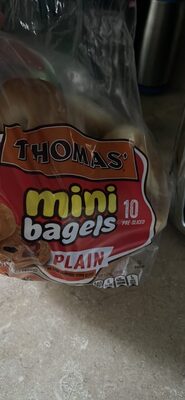
Thomas mini bagels plain
Limited data.
Nutrition facts panel is not on file for this product. The verdict reflects ingredient signals (NOVA, additive severity) only — not the full nutritional profile.
How it scored 60 / 100
Nutrition
—
No nutrition facts on file
Additives
0 / 30
Severity-weighted
Processing
0 / 10
NOVA group 4
Nutrition snapshot
Nutri-Score
ABCDE
EU 5-tier scale (okay)
NOVA group
4
Ultra-processed
Saturated fat
—
No nutriment data
Serving
85 g
2 bagels (85 g)
Ingredients 22 listed
- 1 Fortified Wheat Flour Wheat flour to which specific micronutrients (typically iron, thiamin, riboflavin, niacin, and folic acid) have been added during milling to…Low
- 2 Water Water intended for human consumption; the most common ingredient in processed foods and beverages. Bottled water is regulated as a food unde…Safe
- 3 Sugar Sucrose, a disaccharide of glucose and fructose, refined from sugarcane or sugar beets.Moderate
- 4 Yeast Single-celled fungus, primarily Saccharomyces cerevisiae, used in fermentation and baking. A whole-food microorganism with millennia of food…Safe
- 5 Salt Sodium chloride (NaCl), a crystalline mineral compound composed of roughly 40% sodium and 60% chloride by mass.Low
- 6 Wheat Gluten Protein component of wheat (gliadin and glutenin), separated from starch.Low
- 7 Calcium Propionate Calcium propionate, the calcium salt of propionic acid, used as a preservative against mold and certain bacteria.Low
- 8 Sorbic Acid Sorbic acid, an unsaturated fatty acid used as a preservative against mold, yeast, and certain bacteria.Low
- 9 Cornmeal Coarse flour ground from dried whole corn (Zea mays) kernels.Safe
- 10 Mono- And Diglycerides Of Vegetable Fatty Acids Mono- and diglycerides of fatty acids (E471), emulsifiers derived from glycerol and fatty acids of plant or animal origin.Moderate
- 11 Sodium Carboxy Methyl Cellulose Sodium carboxymethyl cellulose (cellulose gum, E466) is a chemically modified cellulose derivative.Moderate
- 12 Citric Acid Citric acid (E330), a weak organic acid naturally present in citrus fruit and produced commercially via Aspergillus niger fermentation.Low
- 13 Xanthan Gum Xanthan gum is a high-molecular-weight polysaccharide produced by aerobic fermentation of glucose or sucrose by the bacterium Xanthomonas ca…Low
- 14 Soya Lecithin A naturally occurring mixture of phospholipids (phosphatidylcholine, phosphatidylethanolamine, phosphatidylinositol) extracted from soybean …Low
- 15 Flour Powder from milled grain, typically wheat (Triticum spp.) unless otherwise specified.Low
- 16 Barley Malt Flour Flour milled from barley (Hordeum vulgare) that has been germinated (malted) and dried.Low
- 17 Reduced Iron Elemental iron powder (Fe) produced by reducing iron oxide with hydrogen or carbon monoxide; used as a food fortificant.Low
- 18 Nicotinic Acid Nicotinic acid (niacin or vitamin B3, pyridine-3-carboxylic acid). E375 is the EU additive code for its use as a vitamin/nutrient added to f…Low
- 19 Thiamin Mononitrate Synthetic, stable form of vitamin B1 (thiamine). The nitrate salt is preferred for fortification because it tolerates heat and humidity bett…Low
- 20 Riboflavin Riboflavin (vitamin B2), a water-soluble B vitamin. Used as a yellow-orange food color (E101) and as a vitamin fortificant.Low
- 21 Folic Acid Synthetic form of folate (vitamin B9). Pteroylmonoglutamic acid, a water-soluble B vitamin essential for DNA synthesis and red blood cell fo…Low
- 22 Thiamin Thiamin (vitamin B1) is an essential water-soluble B vitamin.Low
Scan it before you buy it
Get Ube for iOS and Android — point at any barcode, see what's actually in there.
Get the app