Home
›
Funyuns Onion Flavored Rings
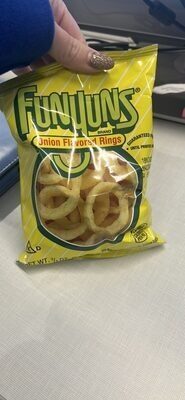
Limited data.
Nutrition facts panel is not on file for this product. The verdict reflects ingredient signals (NOVA, additive severity) only — not the full nutritional profile.
How it scored 70 / 100
Nutrition
—
No nutrition facts on file
Additives
0 / 30
Severity-weighted
Processing
0 / 10
NOVA group 4
Nutrition snapshot
Nutri-Score
ABCDE
EU 5-tier scale (okay)
NOVA group
4
Ultra-processed
Saturated fat
—
No nutriment data
Serving
21 g
1 package (21.2 g)
Ingredients 22 listed
- 1 Cornmeal Coarse flour ground from dried whole corn (Zea mays) kernels.Safe
- 2 Vegetable Oil Generic term covering edible oils extracted from plant sources (soybean, canola, corn, sunflower, palm, etc.).Low
- 3 Salt Sodium chloride (NaCl), a crystalline mineral compound composed of roughly 40% sodium and 60% chloride by mass.Low
- 4 Corn Starch Starch isolated from the endosperm of corn kernels. Composed of amylose and amylopectin (glucose polymers).Low
- 5 Sugar Sucrose, a disaccharide of glucose and fructose, refined from sugarcane or sugar beets.Moderate
- 6 Corn Flour Finely ground flour from corn (maize) kernels; finer than cornmeal.Safe
- 7 Buttermilk Cultured buttermilk is fermented dairy from low-fat milk inoculated with lactic-acid bacteria.Low
- 8 Corn Maltodextrin A short-chain carbohydrate (DE 3-20) produced by partial hydrolysis of corn starch.Low
- 9 Onion The edible bulb of Allium cepa L., a widely cultivated vegetable in the Allium family that also includes garlic, shallots, and leeks.Safe
- 10 Monosodium Glutamate Monosodium glutamate (MSG, E621) is the sodium salt of glutamic acid, a non-essential amino acid.Low
- 11 Dextrose D-glucose, a simple sugar (monosaccharide). Produced commercially by complete enzymatic or acid hydrolysis of corn starch.Moderate
- 12 Hydrolysed Corn Protein Corn protein broken down into smaller peptides and amino acids by acid or enzymatic hydrolysis.Low
- 13 Natural Flavouring A regulatory umbrella term (21 CFR 101.22) for flavor extracts derived from spices, fruit, vegetable, herb, bark, root, leaf, meat, seafood,…Low
- 14 Garlic Allium sativum, a bulbous plant whose cloves are rich in organosulfur compounds — most notably allicin (formed when garlic is crushed) — plu…Safe
- 15 Ferrous Sulfate An iron(II) sulfate salt (FeSO4) used as an iron source for food fortification and dietary supplements.Low
- 16 Nicotinic Acid Nicotinic acid (niacin or vitamin B3, pyridine-3-carboxylic acid). E375 is the EU additive code for its use as a vitamin/nutrient added to f…Low
- 17 Thiamin Mononitrate Synthetic, stable form of vitamin B1 (thiamine). The nitrate salt is preferred for fortification because it tolerates heat and humidity bett…Low
- 18 Riboflavin Riboflavin (vitamin B2), a water-soluble B vitamin. Used as a yellow-orange food color (E101) and as a vitamin fortificant.Low
- 19 Folic Acid Synthetic form of folate (vitamin B9). Pteroylmonoglutamic acid, a water-soluble B vitamin essential for DNA synthesis and red blood cell fo…Low
- 20 Corn Edible cereal grain from Zea mays.Safe
- 21 Canola Canola (Brassica napus) — typically refers to canola oil, a low-erucic-acid rapeseed oil.Low
- 22 Sunflower Oil Edible vegetable oil pressed from the seeds of Helianthus annuus, typically high in linoleic acid (omega-6) or, in high-oleic varieties, ole…Low
Scan it before you buy it
Get Ube for iOS and Android — point at any barcode, see what's actually in there.
Get the app