Home
›
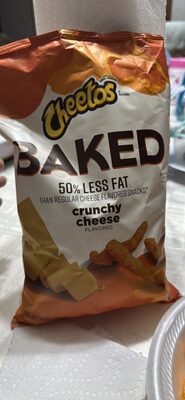
Cheetos BAKED Crunchy Cheese flavored snacks
Why this verdict: 2 high-concern ingredient(s) present.
Limited data.
Nutrition facts panel is not on file for this product. The verdict reflects ingredient signals (NOVA, additive severity) only — not the full nutritional profile.
How it scored 8 / 100
Nutrition
—
No nutrition facts on file
Additives
0 / 30
Severity-weighted
Processing
0 / 10
NOVA group 4
Nutrition snapshot
Nutri-Score
ABCDE
EU 5-tier scale (worst)
NOVA group
4
Ultra-processed
Saturated fat
—
No nutriment data
Serving
28 g
1 portion (28 g)
Ingredients 24 listed
- 1 Cornmeal Coarse flour ground from dried whole corn (Zea mays) kernels.Safe
- 2 Vegetable Oil Generic term covering edible oils extracted from plant sources (soybean, canola, corn, sunflower, palm, etc.).Low
- 3 Whey Liquid or dried protein-rich byproduct of cheese making, derived from milk.Low
- 4 Cheddar Hard cow's milk cheese with FDA standard of identity (21 CFR 133.113); aged from a few months to several years.Safe
- 5 Maltodextrin A short-chain glucose polymer (3–20 glucose units, DE 3–20) produced by partial enzymatic or acid hydrolysis of corn, potato, rice, or wheat…Moderate
- 6 Natural And Artificial Flavouring A blanket label for proprietary flavor mixtures combining naturally derived flavor constituents (essential oils, extracts, distillates) with…Low
- 7 Salt Sodium chloride (NaCl), a crystalline mineral compound composed of roughly 40% sodium and 60% chloride by mass.Low
- 8 Whey Protein Protein fraction isolated from milk whey, the liquid by-product of cheese making, typically as concentrate or isolate powder.Low
- 9 Monosodium Glutamate Monosodium glutamate (MSG, E621) is the sodium salt of glutamic acid, a non-essential amino acid.Low
- 10 Lactic Acid Organic acid (E270) naturally produced by lactic acid bacteria during fermentation; also produced industrially.Low
- 11 Citric Acid Citric acid (E330), a weak organic acid naturally present in citrus fruit and produced commercially via Aspergillus niger fermentation.Low
- 12 Colour Generic ingredient term covering any of dozens of permitted colour additives — synthetic dyes (e.g. tartrazine E102, allura red E129, brilli…Low
- 13 Ferrous Sulfate An iron(II) sulfate salt (FeSO4) used as an iron source for food fortification and dietary supplements.Low
- 14 Nicotinic Acid Nicotinic acid (niacin or vitamin B3, pyridine-3-carboxylic acid). E375 is the EU additive code for its use as a vitamin/nutrient added to f…Low
- 15 Thiamin Mononitrate Synthetic, stable form of vitamin B1 (thiamine). The nitrate salt is preferred for fortification because it tolerates heat and humidity bett…Low
- 16 Riboflavin Riboflavin (vitamin B2), a water-soluble B vitamin. Used as a yellow-orange food color (E101) and as a vitamin fortificant.Low
- 17 Folic Acid Synthetic form of folate (vitamin B9). Pteroylmonoglutamic acid, a water-soluble B vitamin essential for DNA synthesis and red blood cell fo…Low
- 18 Corn Edible cereal grain from Zea mays.Safe
- 19 Canola Canola (Brassica napus) — typically refers to canola oil, a low-erucic-acid rapeseed oil.Low
- 20 Sunflower Oil Edible vegetable oil pressed from the seeds of Helianthus annuus, typically high in linoleic acid (omega-6) or, in high-oleic varieties, ole…Low
- 21 Milk Lacteal secretion from cows or other domesticated ruminants (goats, sheep). Contains water, lactose, milk fat, casein and whey proteins, vit…Low
- 22 Lactic Ferments Live lactic-acid-producing bacterial cultures (typically Lactobacillus, Lactococcus, Streptococcus thermophilus, Leuconostoc) added to milk …Low
- 23 Enzyme Industrial food enzyme — protein catalysts derived from plants, animals, or microorganisms (often via fermentation), added to food to perfor…Low
- 24 Sunset Yellow Fcf Synthetic azo dye (FD&C Yellow No. 6 in the US), water-soluble orange food coloring.High
Scan it before you buy it
Get Ube for iOS and Android — point at any barcode, see what's actually in there.
Get the app