Home
›
BRIANNAS Dijon Honey Mustard Dressing
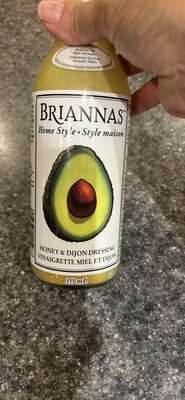
Limited data.
Nutrition facts panel is not on file for this product. The verdict reflects ingredient signals (NOVA, additive severity) only — not the full nutritional profile.
How it scored 45 / 100
Nutrition
—
No nutrition facts on file
Additives
0 / 30
Severity-weighted
Processing
0 / 10
NOVA group 4
Nutrition snapshot
Nutri-Score
ABCDE
EU 5-tier scale (poor)
NOVA group
4
Ultra-processed
Saturated fat
—
No nutriment data
Serving
31 g
2 tbsp (31 g)
Ingredients 24 listed
- 1 Canola Oil Edible oil pressed from low-erucic-acid varieties of Brassica napus or B. campestris (rapeseed). Refined, bleached, deodorized, and standard…Low
- 2 Water Water intended for human consumption; the most common ingredient in processed foods and beverages. Bottled water is regulated as a food unde…Safe
- 3 Dijon Mustard A French-style condiment made from brown/black mustard seeds, white wine or verjuice, water, salt, and spices.Low
- 4 Honey Natural sweet substance produced by honey bees from flower nectar; primarily fructose and glucose.Low
- 5 Sugar Sucrose, a disaccharide of glucose and fructose, refined from sugarcane or sugar beets.Moderate
- 6 White Vinegar Distilled vinegar (typically 4–7% acetic acid in water) made by acetic-acid fermentation of distilled alcohol.Low
- 7 Apple Cider Vinegar Vinegar produced by fermenting apple juice; principal acid is acetic acid.Safe
- 8 White Onion Allium cepa, white-skinned onion variety.Safe
- 9 Salt Sodium chloride (NaCl), a crystalline mineral compound composed of roughly 40% sodium and 60% chloride by mass.Low
- 10 Modified Tapioca Starch Tapioca starch (from cassava root) chemically or physically modified to alter properties.Low
- 11 Turmeric Ground rhizome of the Curcuma longa plant; primary active compound is curcumin.Safe
- 12 Mustard Condiment or ingredient prepared from mustard seeds (Brassica/Sinapis).Low
- 13 Mustard Flavouring Flavoring derived from mustard seed (Brassica or Sinapis species), including extracts and isolated aromatic compounds.Low
- 14 Xanthan Gum Xanthan gum is a high-molecular-weight polysaccharide produced by aerobic fermentation of glucose or sucrose by the bacterium Xanthomonas ca…Low
- 15 Tocopherol-Rich Extract Tocopherol-rich extract — a natural extract of mixed tocopherols (vitamin E forms) from vegetable oils, used as a natural antioxidant.Low
- 16 Vinegar Dilute aqueous solution of acetic acid produced by acetic-acid-bacteria fermentation of ethanol from fruit, grain, or other carbohydrate sou…Safe
- 17 Mustard Seed Seed of mustard plants (Brassica/Sinapis species), used as spice and condiment base.Low
- 18 White Wine Fermented juice of white or green-skinned grapes, containing ethanol typically 9-14% by volume.Moderate
- 19 Citric Acid Citric acid (E330), a weak organic acid naturally present in citrus fruit and produced commercially via Aspergillus niger fermentation.Low
- 20 L(+)-Tartaric Acid L(+)-Tartaric Acid — a naturally occurring dicarboxylic acid found abundantly in grapes; used as a food additive.Low
- 21 Spice A regulatory category (21 CFR 101.22) for aromatic vegetable substances used primarily for seasoning. Excludes onion, garlic, and celery, wh…Moderate
- 22 Colour Generic ingredient term covering any of dozens of permitted colour additives — synthetic dyes (e.g. tartrazine E102, allura red E129, brilli…Low
- 23 Antioxidant Functional class label for substances added to retard oxidative rancidity (e.g., tocopherols, ascorbic acid, BHA, BHT, TBHQ, rosemary extrac…Low
- 24 Vitamin E Fat-soluble vitamin (alpha-tocopherol and related tocopherols/tocotrienols); essential nutrient and antioxidant.Low
Scan it before you buy it
Get Ube for iOS and Android — point at any barcode, see what's actually in there.
Get the app