Home
›
Lactaid Cottage cheese
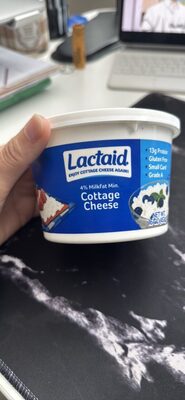
Limited data.
Nutrition facts panel is not on file for this product. The verdict reflects ingredient signals (NOVA, additive severity) only — not the full nutritional profile.
How it scored 85 / 100
Nutrition
—
No nutrition facts on file
Additives
0 / 30
Severity-weighted
Processing
0 / 10
NOVA group 4
Nutrition snapshot
Nutri-Score
ABCDE
EU 5-tier scale (okay)
NOVA group
4
Ultra-processed
Saturated fat
—
No nutriment data
Serving
113 g
1/2 cup (113 g)
Ingredients 15 listed
- 1 Pasteurized Skimmed Milk Cow's milk with the cream removed (skim/non-fat) and heat-treated to kill pathogens.Low
- 2 Cream The fat-rich liquid separated from milk. FDA standards of identity (21 CFR 131.150 / 131.155 / 131.157) classify by milkfat content: heavy c…Safe
- 3 Whey Protein Protein fraction isolated from milk whey, the liquid by-product of cheese making, typically as concentrate or isolate powder.Low
- 4 Whey Liquid or dried protein-rich byproduct of cheese making, derived from milk.Low
- 5 Salt Sodium chloride (NaCl), a crystalline mineral compound composed of roughly 40% sodium and 60% chloride by mass.Low
- 6 Natural Flavouring A regulatory umbrella term (21 CFR 101.22) for flavor extracts derived from spices, fruit, vegetable, herb, bark, root, leaf, meat, seafood,…Low
- 7 Lactase Beta-galactosidase enzyme that hydrolyzes lactose into glucose and galactose, produced from microbial sources (e.g., Aspergillus oryzae, Klu…Low
- 8 Xanthan Gum Xanthan gum is a high-molecular-weight polysaccharide produced by aerobic fermentation of glucose or sucrose by the bacterium Xanthomonas ca…Low
- 9 Locust Bean Gum Galactomannan polysaccharide extracted from seeds of the carob tree (Ceratonia siliqua).Low
- 10 Guar Gum Polysaccharide (galactomannan) extracted from the seeds of the guar plant (Cyamopsis tetragonoloba). E-number E412.Low
- 11 Lactic Acid Organic acid (E270) naturally produced by lactic acid bacteria during fermentation; also produced industrially.Low
- 12 Sorbic Acid Sorbic acid, an unsaturated fatty acid used as a preservative against mold, yeast, and certain bacteria.Low
- 13 Carbon Dioxide Carbon dioxide (CO2), an inert gas used in foods primarily for carbonation and as a propellant or atmosphere.Safe
- 14 Enzyme Industrial food enzyme — protein catalysts derived from plants, animals, or microorganisms (often via fermentation), added to food to perfor…Low
- 15 Preservative Generic umbrella term for unspecified preservative additive(s).Low
Scan it before you buy it
Get Ube for iOS and Android — point at any barcode, see what's actually in there.
Get the app