Free Food Diary Printable (PDF)
A clean one-day-per-page food diary with meal sections, portion and macro columns, a water tracker, and a hunger note. Free PDF, no email required.

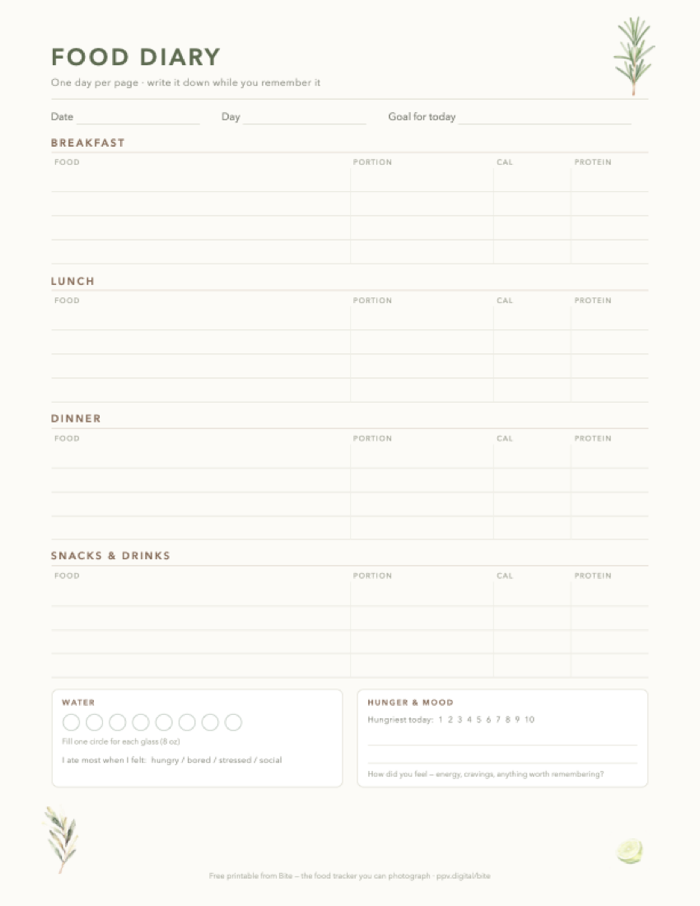
Here is a free food diary you can print today — one day per page, no sign-up, no email gate. It is deliberately plain: four meal sections, room to write what you ate and roughly how much, and small columns for calories and protein if you happen to know them. Leaving those blank is fine. Most of the value is in writing the food down at all.
What’s on the page
Breakfast, lunch, dinner, and a combined snacks & drinks section — four lines each, which is more than most days need and enough for the days that get away from you. Each line has a wide space for the food, a portion column (“1 palm,” “2 cups,” “half the container” are all valid), and narrow calorie and protein columns. At the bottom: eight water circles to fill in, a 1–10 hunger scale, and two lines for mood — because the pattern you are usually looking for is not in the food, it is in when and why you ate it.
How to actually use it
Write it down while you are still at the table. Recall accuracy falls off fast, and research on self-reported intake consistently finds people under-report by a wide margin — almost never on purpose, just because the handful of chips and the bite off someone else’s plate never make it to the page. Do not weigh anything at first; if you want to sharpen portions later, our guide on tracking calories without weighing your food covers the hand and household-object method.
The part nobody warns you about
Paper logging is the highest-friction part of tracking, and it is the single biggest reason food diaries get abandoned in week two. The page is genuinely great for starting out — it is fast to set up, it costs nothing, and it teaches you what a portion looks like. It is also the thing you left in your bag at the restaurant, and the reason Wednesday’s dinner is blank.
If you get to that point and want to keep going, that is exactly what Bite is for: take a photo of the plate, or say what you ate, and the meal gets logged with calories and macros — no typing, no database search, no scale. Same habit, none of the writing. And if you would rather keep the paper, keep the paper. A diary you actually fill in beats an app you stop opening.
Not sure how to fill in the macro columns yet? Start with how to count macros for beginners — it covers what the numbers mean and how to set targets without turning dinner into arithmetic.
Track your meals in seconds with Bite
Snap a photo, say it, or type it — AI logs your calories and macros from real USDA nutrition data. Free.