Free Printable Bedtime Routine Chart for Kids
A print-ready visual bedtime routine chart with watercolor illustrations and nightly color-in circles. Free PDF, no email required.
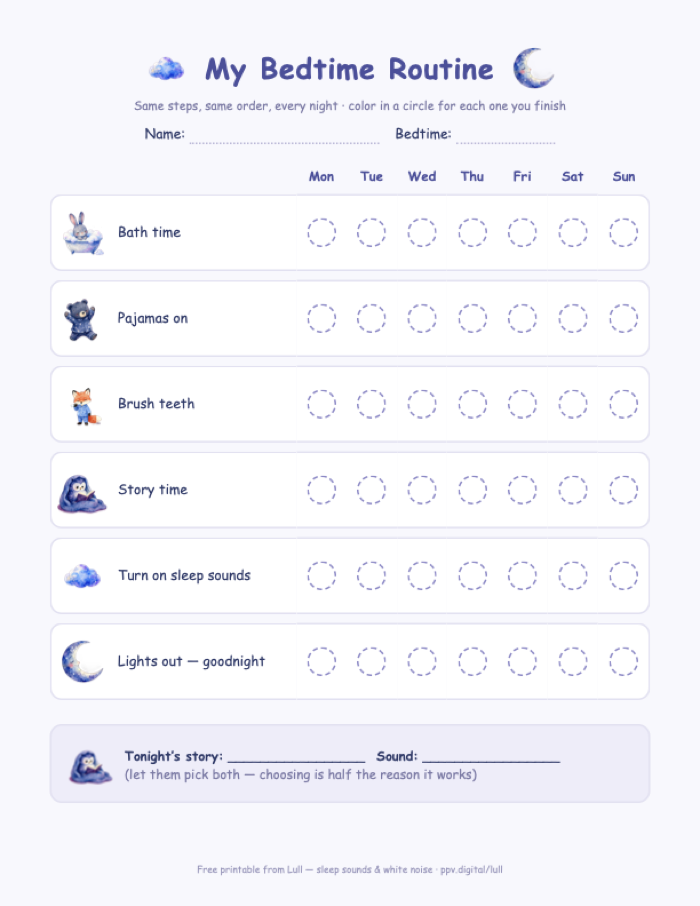
Here is a free bedtime routine chart for kids who can’t read yet. Six steps, each one a picture, in the order you actually do them. Print it, tape it at your kid’s eye level, and let them color in a circle for each step they finish. No sign-up, no email gate, just the PDF.
What’s on the chart
Six steps in a fixed order: bath time, pajamas on, brush teeth, story time, turn on sleep sounds, lights out. Each has its own watercolor illustration, so a two-year-old can follow it without anyone reading it to them. Every night of the week gets a dashed circle to color in — more satisfying than a checkbox at this age, and it doubles as fine-motor practice. At the bottom there is a line for tonight’s story and tonight’s sound, because letting them choose is a big part of why this works.
Why a routine (and why a chart)
A consistent bedtime routine is the most evidence-backed thing you can do for a young child’s sleep — it moves the needle on how fast they fall asleep and how often they wake up, more reliably than any gadget. The catch is that “consistent” means the same steps in the same order, and that is exactly what falls apart at 7pm when everyone is tired. Putting the sequence on the wall moves it out of your head. The kid stops asking what’s next, and the argument shifts from “it’s bedtime” to “what does the chart say?”
Making the sound step stick
Sound is the last step for a reason: it’s the cue that stays on after you leave the room, and it covers the hallway noise, the dishwasher, and the sibling who is still awake. If you want the background on that, we wrote up what’s safe and what works with white noise for babies (volume and distance matter more than most people realize), and the seven ways sound actually helps you fall asleep faster.
The honest failure mode of any paper chart: it works for about three weeks, then someone stops coloring the circles. The routine usually survives — the tracking doesn’t. That’s fine. What I’d actually keep is the sound step, which is the part that has to run every night without a person managing it. Lull handles that one: pick a sound, set a fade timer, and it plays offline until they’re out — and it’s there for your own wind-down an hour later, which is the part of the bedtime routine nobody prints a chart for.
Sleep better with Lull
Mix ambient sounds into your perfect sleep soundtrack. Free, no subscriptions.